
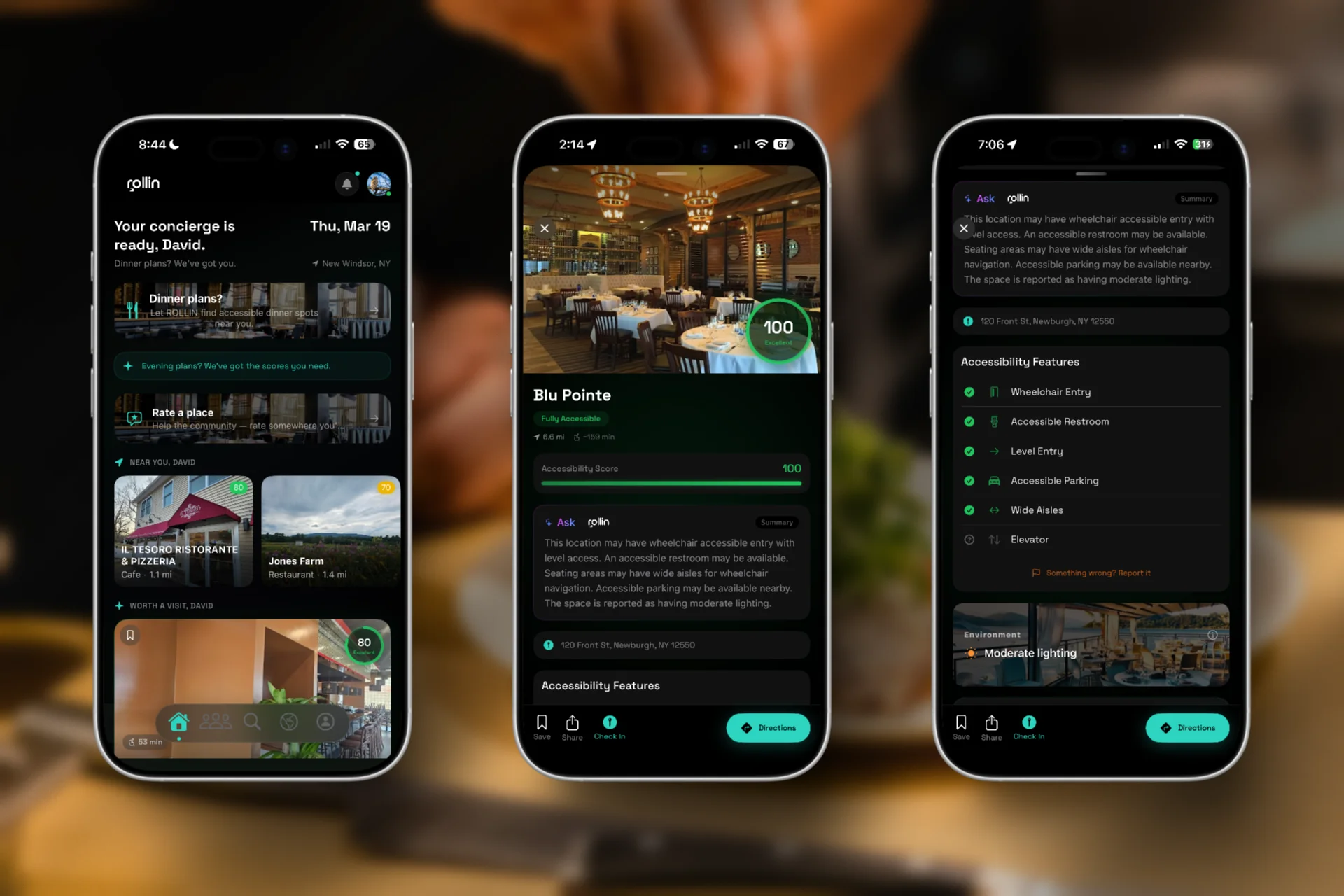
Google Maps gives you an unverified checkbox. AbleVu charges $299/yr for ~200 profiles. Wheelmap uses a shallow traffic light. None of them have real data. ROLLIN is a vertical AI platform with 105,000+ venues scored across 15 states, trust-weighted community verification, a REST API, and an MCP server that lets AI assistants query autonomously. Real data. Not a checkbox.
Five platforms. Five ways of telling you almost nothing.
Score 92/100. 5 of 6 features confirmed. Elevator unverified (single-floor venue). Verified by 3 trusted contributors.
An honest breakdown of what each platform actually delivers for wheelchair accessibility.
| Dimension | ★ROLLIN | Yelp | Wheelmap | AXS Map | AbleVu | |
|---|---|---|---|---|---|---|
| Scoring System | 0-100 weighted | Yes / No | None | 3 colors | 1-5 scale | Pass / Fail |
| Features Tracked | 6 specific | 1 flag | 1 mention | 3 categories | Varies | Manual audit |
| Community Verified | Trust-weighted | Self-reported | User reviews | Crowdsourced | Crowdsourced | No |
| Public API | REST + MCP + SDK | Buried in Places | No | Deprecated | No | No |
| Score Transparency | Full breakdown | Black box | N/A | No scoring | No breakdown | No scoring |
| US Coverage | 15 states, 48 regions | Wide but shallow | Wide, no scoring | Very limited | NYC only | ~8 cities |
| Consumer Cost | Free for users | Free | Free | Free | Free | Free |
| Business Listing Cost | Free to list | Free | Free | Free | Free | $299/yr |
| Scalability | Automated pipeline | Global | Global | Crowdsource-limited | NYC only | Months per city |
Three things create the data moat competitors can't replicate.
Every location is evaluated across six real-world accessibility dimensions. Not a single binary flag.
A 0-100 scale weighted by real-world impact. Can you get in the door? Can you use the restroom? Those carry more weight.
Community feedback from people with lived experience. Contributions are trust-weighted for accuracy.
From national touring shows to city advocacy groups. real partners, not paid logos.
Restaurants across 15 states use ROLLIN to reach the disability community actively searching for accessible dining: wheelchair users, walker and cane users, families with strollers, and people with light sensitivity. Featured placements, verified scores, real customers.
For restaurantsIndependent Living Centers, disability advocacy orgs, and nonprofits use ROLLIN data to help their communities find accessible dining. no cost, no contracts, no gatekeeping.
Partner with usThe only public accessibility API in the market. REST endpoints, MCP Server for AI agents, and a Python SDK. developers are building accessibility into their apps with ROLLIN data.
Explore the API105,000+ venues scored across 15 states. Real data pipeline. Trust-weighted community verification. REST API + MCP server for AI agents + Python SDK. The accessibility intelligence infrastructure competitors can't replicate.
Six accessibility features. One trusted score. Zero phone calls.
ROLLIN is a vertical AI platform purpose-built for wheelchair accessibility, with real data on 105,000+ venues across 15 states and 48 regions. Unlike Google Maps (unverified checkbox), Wheelmap (shallow traffic-light system), or AbleVu ($299/yr for ~200 profiles), ROLLIN provides granular 0-100 scores based on 6 features, trust-weighted community verification, a public REST API, an MCP server for AI assistants, and a Python SDK.
Google Maps offers an unverified checkbox. self-reported by business owners. ROLLIN is a vertical AI platform with real data: 0-100 scores across 6 features, trust-weighted community verification from real wheelchair users, and transparent scoring. ROLLIN also offers a REST API, MCP server for AI agents, and a Python SDK by Stainless.
Yes, ROLLIN is 100% free for end users. Search for accessible restaurants and bars, view accessibility scores, and save favorites at no cost. ROLLIN also offers a free API tier for developers.
ROLLIN tracks 6 key accessibility features: wheelchair entry, accessible restroom, level entry (no steps), accessible parking, wide aisles, and elevator access. Three of these (wheelchair entry, accessible restroom, level entry) are designated as critical features that carry the most weight in scoring.
ROLLIN uses a scoring engine that evaluates 6 accessibility features to produce a 0-100 score. Each feature has a weighted impact based on real-world importance. When critical features are unverified, the score is capped below the highest tier to prevent false confidence. Scores are transparent. users can see which features are present, absent, or unverified.