

The search box is dead. The data layer underneath it just became everything.
Google used I/O 2026 to replace the search box with an AI-routed surface and background agents that act for you. ROLLIN spent three years building accessibility data for exactly this.

Today at I/O 2026, Google announced what it called the biggest change to Search in 25 years. The box now expands as you type. It takes images, files, videos, and open browser tabs as inputs. It opens straight into AI Mode, powered by Gemini 3.5 Flash. And from this summer, a new class of “information agents” will keep running in the background, watching the topics you hand them and pushing updates when something changes.
The press is calling it a redesign. What Google actually did was concede the point its whole business was built to deny: the ten blue links are on their way out, and the search box is being retired as the main doorway between people and the internet.
The unit of consumption is no longer a ranked list of links. It is an answer assembled by a model.
For most companies, that is going to be a hard few years. ROLLIN spent three of them building for it.
What actually changed
The headline is the box. The shift is structural. Google has stopped treating AI as a feature bolted onto Search and started treating it as the surface itself. Follow-up questions stay in one conversation. Personal Intelligence pulls in Gmail, Photos, and soon Calendar, so the model already knows something about you when it answers. The new information agents keep working after you walk away, tracking prices, traffic, housing, and whatever else you ask them to watch.
The work the user used to do shrinks to two steps: ask, then accept or reject. The middle step — reading ten links and making your own call — moves to the model.
SEO teams will feel the ground move first. For anyone building data that an agent might consume, the same announcement reads as a starting gun.
What an agent actually needs
An agent, in the way Google now uses the word, takes a goal from a person, breaks it into steps, runs those steps against the tools and data it can reach, and hands back a result.
For that to work on a question about the physical world, the underlying data has to be built for a machine to read. It can’t be scraped from a thousand inconsistent pages, reconciled from reviews that contradict each other, or guessed from a photo of a doorway. It has to be structured, scored, versioned, and queryable.
The broader web has not solved this. Most industries are about to be forced to. In accessibility, no one was solving it when we started, which is the reason ROLLIN exists.
What we built, and why
Three years ago, the question behind every architectural decision at ROLLIN was not how to make a nicer accessibility app for people to tap through. It was a stranger question:
What does accessibility data need to look like when humans are no longer the ones reading it?
The answer came in three parts.
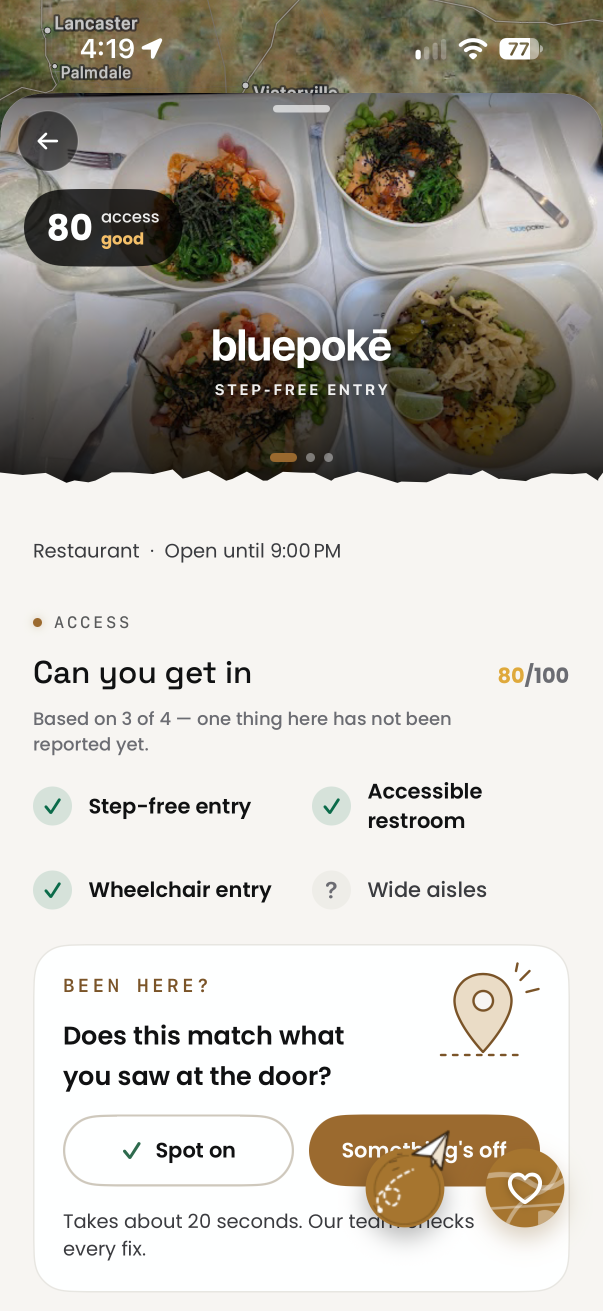
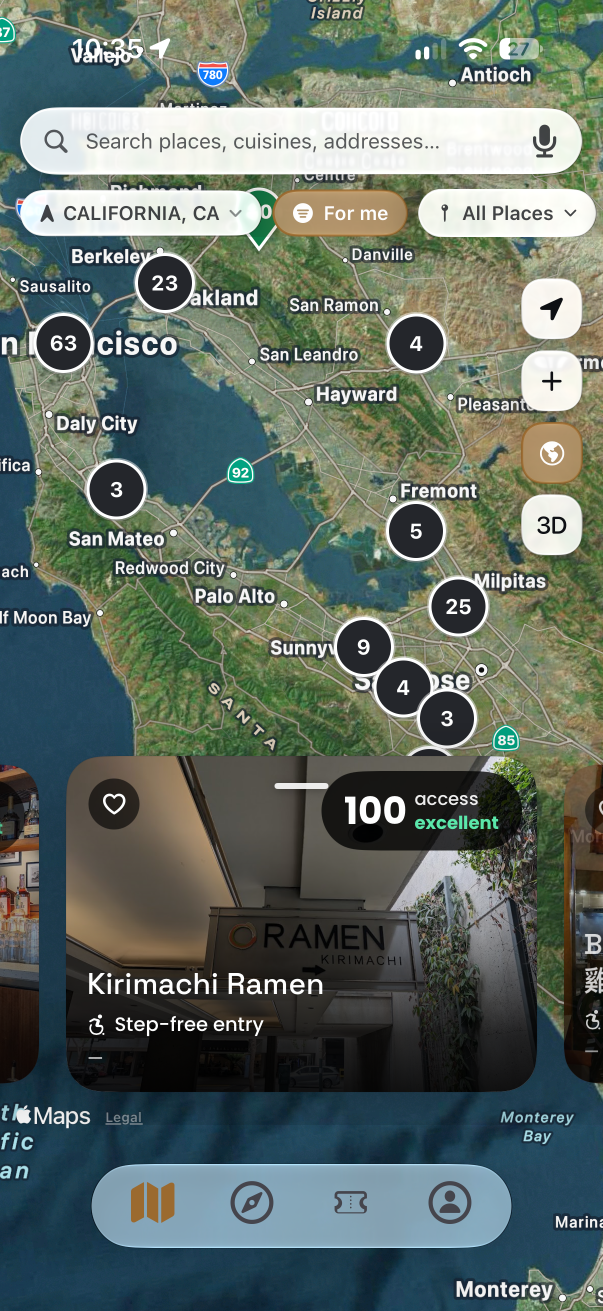
It has to be standardized. One 0–100 score across 105,000+ venues in 16 states, computed the same way everywhere from six weighted physical accessibility features, with measured lighting and noise data layered in. A specific number backed by specific features, with the math shown, instead of a vague “mostly accessible.”
It has to be honest about its own limits. An agent that confidently recommends a venue on stale or guessed data does more harm than one that admits it doesn’t know. Our scoring engine reports how sure it is alongside the score, so a model can tell the difference between verified and assumed.
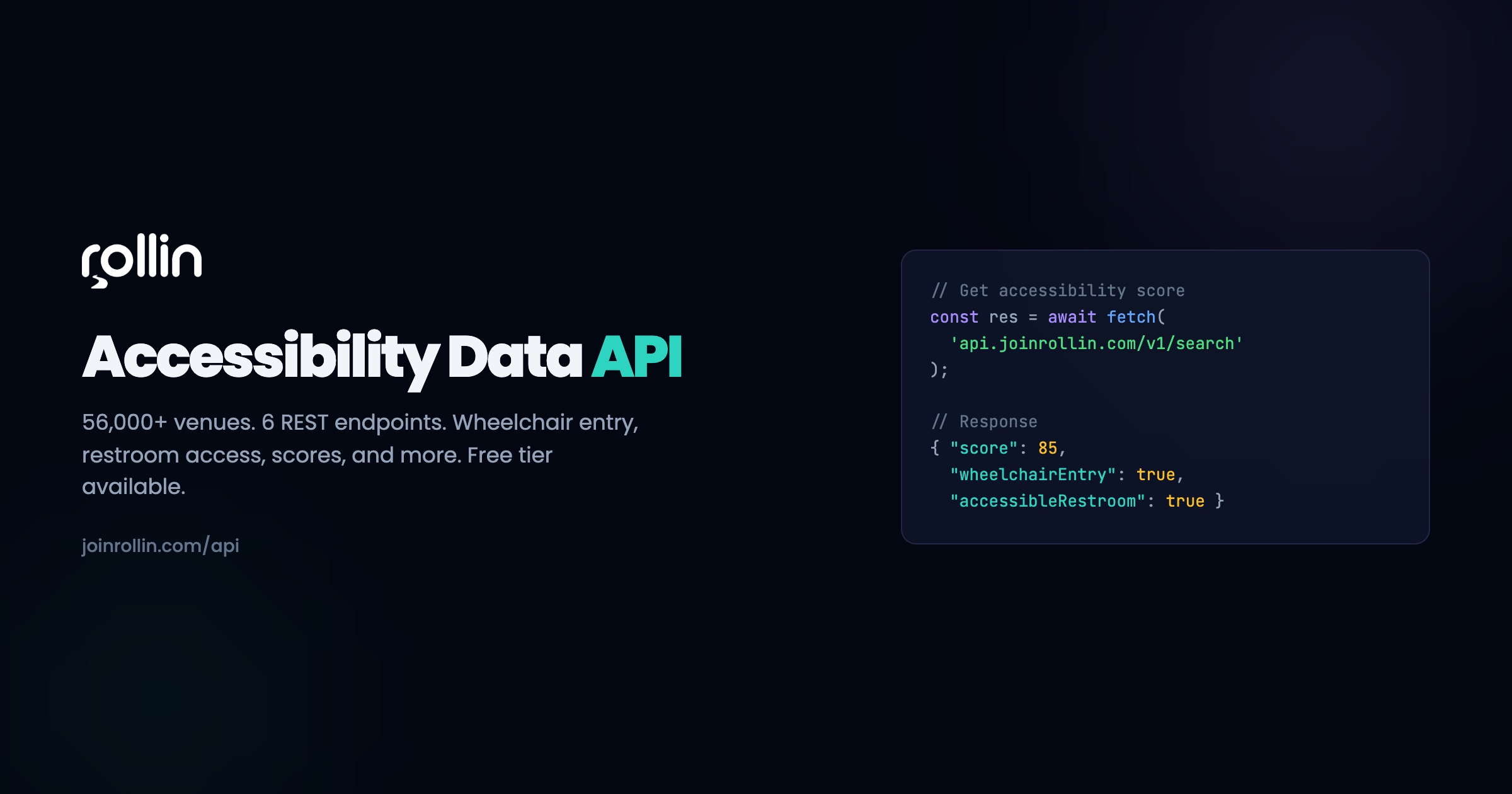
It has to be readable by machines, not only people. A public REST API. A Python SDK on PyPI. An MCP server on the GitHub registry, shipped before most people could say what MCP stood for. The API is the single source of truth; our own iOS app is just one of its clients.
Three years ago those calls sounded paranoid. The wager was that the agent era was coming, and that any venue or platform whose accessibility data wasn’t built for machines would be invisible to it. Today the wager stopped being one.
What this means for venues
If you run a restaurant, a theater, a hotel, a gym, or any other physical space, the I/O announcement carries an uncomfortable implication: the way disabled customers find you is changing, and you don’t control how.
A wheelchair user in 2024 might have searched “accessible restaurants near me,” scrolled the results, read reviews, studied photos, and called ahead. A wheelchair user in 2027 will ask their agent for a quiet, step-free dinner with accessible parking and a restroom they can actually use, and the agent will return one or two names. Yours is on that shortlist or it isn’t.
What decides it is whether your accessibility is legible to the agent. If the only available signal is a sentence someone typed into a review in 2019, you are illegible. If your accessibility is documented in a structured, verifiable way — by us or by a comparable provider — you are in the running.
The venues that win the next decade won’t be the ones with the best SEO. They’ll be the ones whose accessibility a machine can query.
What this means for developers
If you build anything that recommends, ranks, or routes people through physical space, your users are about to start asking questions your current data can’t answer.
You can ignore that, and your competitors won’t. You can try to build the accessibility data yourself, which is slow, expensive, and prone to exactly the inconsistency that makes models hallucinate. Or you can build on infrastructure that already exists.
The ROLLIN API is public. The Python SDK is on PyPI. The MCP server is on the GitHub registry. We did the unglamorous part so you don’t have to.
What this means for the disability community
This is the part that matters most, underneath the analyst language.
Finding out whether a place is accessible has always been a tax disabled people pay before they leave the house. The phone calls. The review deep-dives. The arriving, and the turning around. ROLLIN exists because our founder watched his father pay that tax for years.
That tax is about to be paid by software instead, and the time it gives back goes to the people who have been paying it all along. That is the entire point of ROLLIN. The Search redesign only moved the timeline up.
The takeaway
Google didn’t ship a feature today. It signaled that the era of people typing keywords into a box is closing, and the era of agents acting for them is opening. Every category of structured data, accessibility included, is about to be judged on one question: can an agent use this?
For accessibility, the answer is yes — because we built it that way on purpose. For much of the rest of the internet, the next few years are going to be loud.
ROLLIN is the accessibility intelligence platform — a 0–100 score for 105,000+ venues, built for humans and the agents acting on their behalf.
What did Google announce about Search at I/O 2026?
Google made AI Mode the default Search surface, powered by Gemini 3.5 Flash. The box accepts images, files, videos, and browser tabs as inputs, keeps follow-up questions inside one conversation, and introduces background “information agents” that monitor topics and push updates after you close the tab. In practice, the ranked list of ten blue links is being retired as the primary interface.
Why does the move to AI agents matter for accessibility?
When an agent books a restaurant or plans an outing, it relies on whatever data it can read. If a venue’s accessibility only exists as a 2019 Yelp comment or a binary checkbox, the agent has nothing trustworthy to use. Disabled people get recommended places they cannot actually enter. The gap is not that agents ignore accessibility; it is that accessibility data rarely exists in a form an agent can query and trust.
What does an AI agent need to recommend an accessible place?
Data that is structured, scored, versioned, and queryable through an API. It cannot rely on text scraped from inconsistent web pages, contradictory reviews, or features guessed from photos. It needs specific facts, step-free entry, accessible restroom, accessible parking and wide aisles, each with a confidence level and a single canonical source.
How does ROLLIN make accessibility data available to AI agents?
ROLLIN scores 105,000+ venues across 16 US states on a 0 to 100 scale from six physical accessibility features plus measured lighting and noise data, and exposes that data through a public REST API, a Python SDK on PyPI, and an MCP server on the GitHub registry. The API is the single source of truth; ROLLIN’s own iOS app is just one client of it, so anything an agent needs is already machine-readable.
What should venues do to stay visible in the agent era?
Make your accessibility legible to machines. A venue whose step-free entry, restroom, and parking are documented in a structured, verifiable way can be surfaced by an agent; one whose only signal is an old review cannot. Getting your venue scored, by ROLLIN or a comparable provider, is how you stay in the answer an agent returns.